
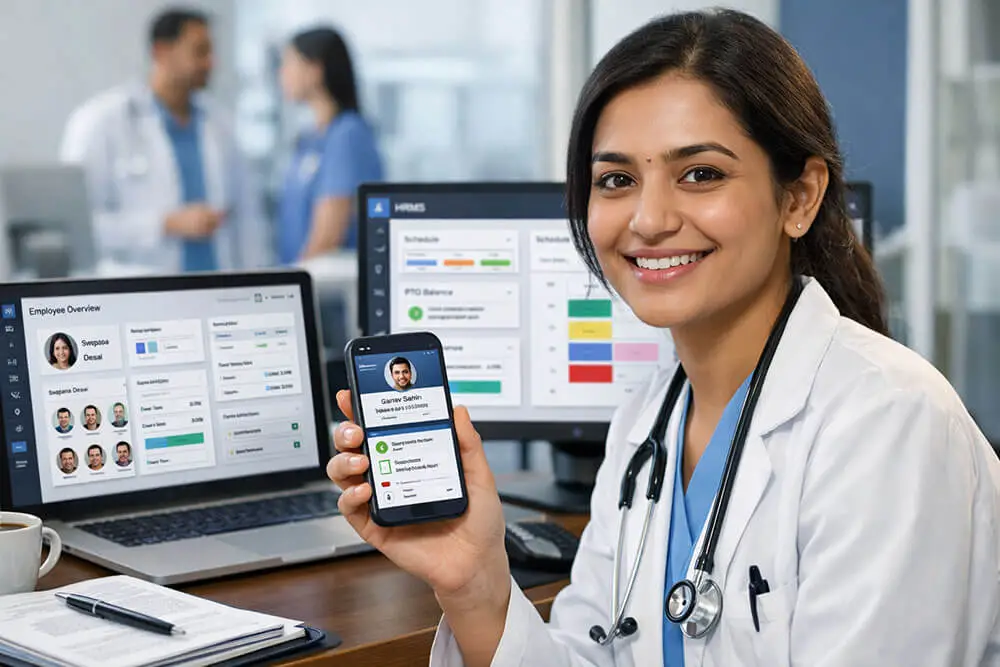

Hospitals rely on people as much as they rely on technology. Doctors, nurses, technicians, administrative teams, support staff, and management all play essential roles in delivering safe and efficient healthcare services.
Managing this large and complex workforce manually can create serious challenges. Many hospitals still depend on spreadsheets, paper records, separate payroll systems, and outdated scheduling methods. This often leads to:
These issues affect both employee satisfaction and hospital performance.
This is why investing in an HR system for hospitals has become essential for modern healthcare organizations.
A hospital HR system helps centralize employee records, automate scheduling, manage payroll, monitor attendance, track performance, and support compliance through one connected platform.
In this guide, we explain what an HR system for hospitals is, why hospitals need it, key features, benefits, and how NitcoTek helps healthcare providers modernize workforce management.
An HR system for hospitals is a workforce management platform specifically designed to support the staffing and human resource needs of hospitals, healthcare groups, medical centers, and specialized care facilities.
Unlike general HR software, hospital-focused systems are built to manage healthcare-specific workforce requirements such as:
This helps hospitals operate more efficiently while maintaining proper staffing levels.
If you're exploring complete workforce and operational control, read about Hybrid Healthcare Management System
Healthcare environments are more complex than standard office workplaces. Hospitals need software that can handle:
A specialized HR system for hospitals is built to manage these realities effectively.
Hospitals operate around the clock. Workforce planning directly impacts patient care, productivity, and operating costs.
Without a dedicated HR system, hospitals may face:
A healthcare-focused HR solution helps solve these issues systematically.
Hospitals often employ hundreds or thousands of staff members across multiple departments.
Managing records, schedules, leave requests, payroll, and performance manually becomes inefficient and risky at scale.
Unlike many businesses, hospitals require continuous staffing.
This includes:
An HR system for hospitals helps ensure the right people are assigned to the right shifts.
Uncontrolled overtime increases labor costs significantly.
A digital HR platform helps track:
Healthcare providers must maintain organized workforce documentation such as:
Digital systems simplify compliance readiness.
Payroll mistakes damage employee trust and create operational issues.
Automated payroll improves accuracy while helping management control labor costs.
Leadership teams need instant access to:
Real-time dashboards support faster decisions.
See how integrated hospital platforms support HR, finance, and operations through Online Clinic ERP System
Every employee should have a complete digital profile containing:
This centralizes workforce records.
One of the most valuable features of an HR system for hospitals is scheduling automation.
It can help manage:
Better scheduling improves service continuity.
Attendance modules support:
This improves accountability and payroll accuracy.
Payroll features often include:
This reduces errors and saves HR time.
Hospitals frequently hire clinical and non-clinical staff.
A digital HR platform may support:
This accelerates hiring.
Hospitals need strong performance oversight.
This may include:
Better performance management supports retention and service quality.
Healthcare staff often require active licenses and mandatory training.
The system can track:
This is especially valuable for regulated healthcare environments.
Leadership teams need visibility into workforce trends.
Useful dashboards include:
Automation reduces administrative delays and improves workforce coordination.
Digital payroll systems reduce disputes and improve employee trust.
Smart scheduling ensures departments remain properly staffed.
HR teams save time by automating repetitive tasks.
Digital records make documentation easier to manage and review.
Clear schedules, timely payroll, and organized processes improve staff experience.
As hospitals expand, an HR system for hospitals can scale with additional departments, users, and branches.
Hospitals can assign qualified staff where they are most needed.
Monitoring overtime helps lower unnecessary labor costs.
Recruitment workflows reduce delays in filling urgent vacancies.
Management can measure department efficiency more accurately.
HR analytics help identify turnover risks and workforce trends.
Single facilities benefit from:
Healthcare groups need:
This is where advanced HR system for hospitals platforms create major value.
Cloud systems are often ideal for growing healthcare organizations.
Choose a provider that understands hospital staffing realities and healthcare HR workflows.
The system should support:
Ensure strong payroll automation with support for allowances, overtime, and deductions.
HR data must be protected with role-based permissions and secure hosting.
Your system should grow with expanding workforce needs and new branches.
Reliable onboarding, training, and technical support are essential.
Choose a system with clear dashboards and workforce intelligence tools.
NitcoTek provides specialized healthcare technology solutions that help hospitals modernize HR operations and workforce management.
NitcoTek systems can connect HR functions with broader hospital workflows such as finance, administration, and reporting.
Whether managing one hospital or a multi-location group, NitcoTek solutions support expansion and operational consistency.
NitcoTek helps healthcare providers improve payroll control and workforce visibility through structured digital tools.
Security, continuity, and operational reliability are key priorities in NitcoTek healthcare systems.
NitcoTek supports clients through onboarding, deployment, training, and long-term technical assistance.
It is a workforce management platform designed to help hospitals manage scheduling, payroll, attendance, employee records, and HR operations.
Because hospitals operate 24/7, manage complex staffing needs, and require compliance-focused workforce control.
Yes. Modern systems can automate rosters, rotations, and department staffing coverage.
Yes. Trusted systems use secure hosting, backups, and controlled access permissions.
Yes. Many advanced systems support centralized HR management across multiple locations.
Hospitals depend on people to deliver safe, efficient, and high-quality care. Without organized workforce management, hospitals may face scheduling problems, payroll errors, compliance risks, and operational inefficiencies.
An HR system for hospitals helps centralize workforce operations, improve scheduling, automate payroll, track performance, and support long-term growth.
From staffing visibility to stronger compliance and better employee experience, the right HR system creates measurable value across the organization.
NitcoTek helps healthcare providers modernize workforce management through healthcare-focused digital solutions designed for efficiency, visibility, and sustainable growth.
Discover how NitcoTek’s advanced HR system for hospitals can streamline scheduling, improve payroll accuracy, and support sustainable growth.
Request a consultation or demo today.